


GEORGE SARWAH STEWART EXPLAINS WHY ETHICAL JOURNALISM IN AFRICA IS UNDER PRESSURE AT JFC FELLOWSHIP
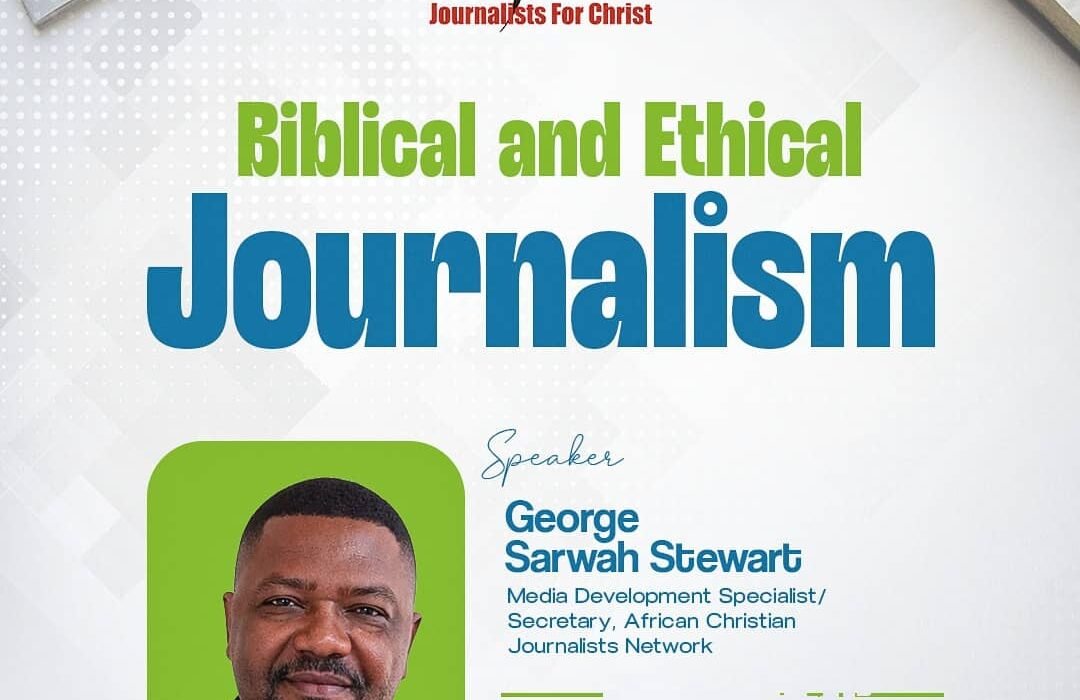
A Liberian journalist and media development specialist, Mr George Sarwah Stewart, has observed how ethical journalism in Africa is declining not because journalists lack training or knowledge of professional codes, but because intense political pressure, economic hardship and weak institutional support systems are undermining newsroom independence.
Mr Stewart made the remarks during the Journalists for Christ (JFC) monthly fellowship, where he spoke on “Ethical Journalism in a Time of Pressure: A Charge to Journalists of Faith.”
He argued that the decline in ethical standards across the continent is not due to ignorance or lack of training, but because journalists are operating in environments where “the pressure is intense, survival is uncertain, and support systems are weak.”
According to Mr Stewart, most journalists understand professional ethics and codes of conduct. However, political interference, financial inducements, job insecurity and weak institutional backing often influence editorial decisions.
He said when stories affect powerful political, economic or religious interests, journalists frequently face subtle negotiations, threats or financial temptations aimed at suppressing publication.
“In those moments, the struggle is not with facts, but with conscience,” he said, adding: “You may survive if you compromise— but at what cost?”
Mr Stewart told participants that journalists of faith carry what he described as a dual responsibility— professional accountability to the public and spiritual accountability before God.
“As journalists of faith, the pressure is doubled,” he said. “We answer to professional standards and to a higher moral calling.”
He urged practitioners to set ethical boundaries before encountering pressure, noting that courage comes from conviction rather than training alone.
Describing journalism as a “truth-telling discipline,” Mr Stewart stressed that loyalty to truth remains the foundation of the profession.
“Without truth, there is no journalism,” he said, warning that the profession loses credibility when it becomes a tool for political power, tribal loyalty, religious protectionism or personal gain.
He also called on journalists to defend marginalised voices rather than amplify only political elites.
“Journalism that highlights politicians but ignores rural communities, market women and victims of abuse may appear professional, but it is not just,” he stated.
Mr Stewart acknowledged structural challenges facing African media, including low pay, political ownership of media organisations, patronage journalism, censorship and safety concerns.
He said social media has intensified pressure by rewarding speed over accuracy, contributing to misinformation.
Despite these obstacles, he maintained that the future of ethical journalism ultimately depends on personal moral resolve
“Ethical journalism will not be saved by codes alone,” he concluded. “It will be saved by men and women of conscience who believe that truth still matters.”